
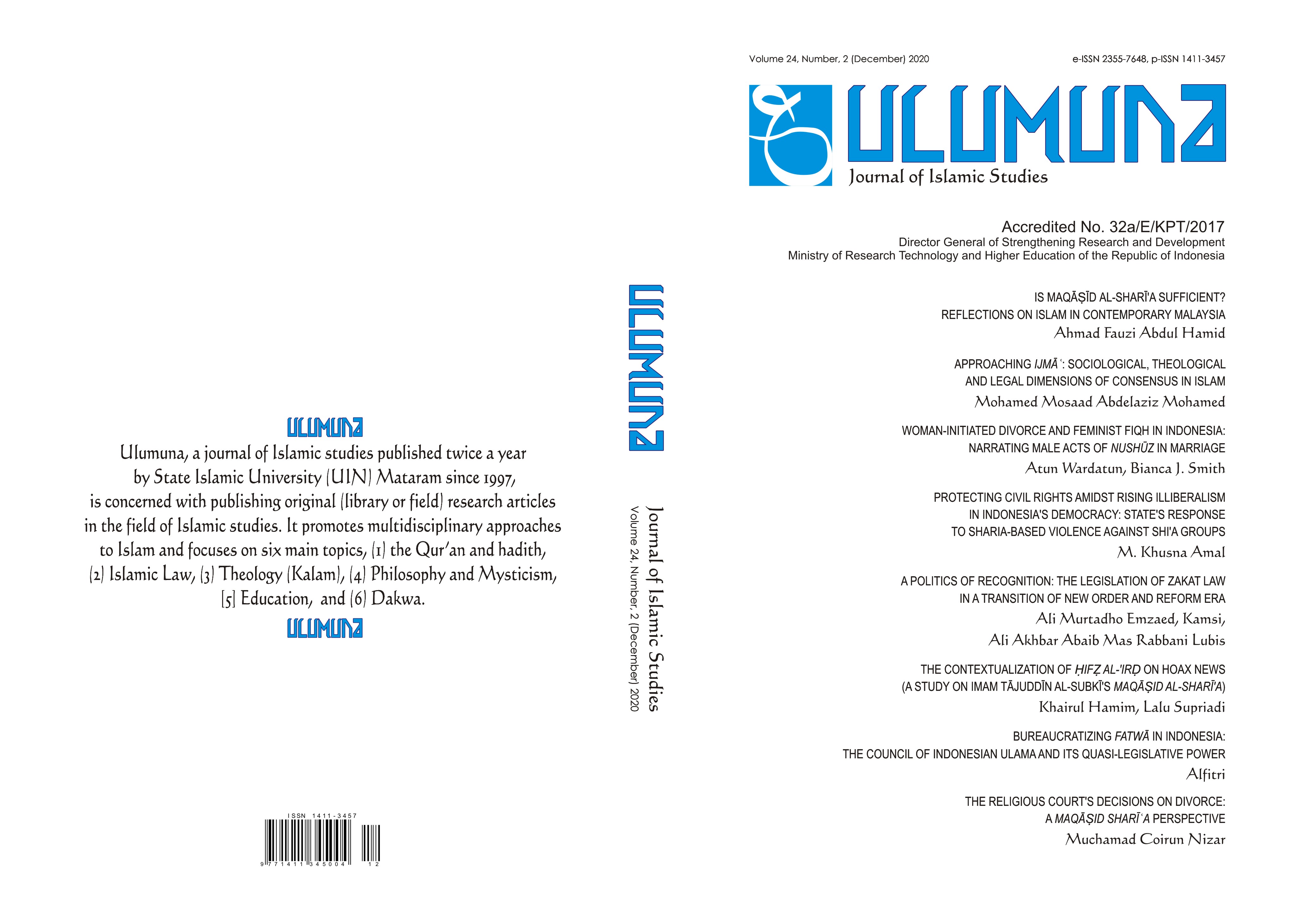
Protecting Civil Rights Amidst Rising Illiberalism in Indonesia’s Democracy: State’s Response to Sharia-Based Violence Against Shi’a Groups
Abstract
This article examines the local government and state representation in response to religious violence against Shi’a minority groups. Intensive scholarly debates on this issue have ignited, especially on what made the government showed an exclusive response to religious violence. Scholars have argued that state agencies commonly tend to take a safe position though no contradictory policies that please conservative groups. This research was conducted through six-month fieldwork in Bondowoso regency, East Java province, in 2017 and 2018. The data was collected through ethnography and in-depth interviews with relevant sources. In this study, I argue that not all government agencies respond exclusively to violence against minority communities. Through a case study on Sunni-Shi'a tension in Bondowoso, East Java, this study reveals that the local government showed inclusive attitudes to protect the rights of Shi'a adherents to practice their faiths. Such responses are aimed to maintain well-developed plurality, harmony, and civil rights for minority citizens of Bondowoso. This study confirms that inclusive local state officials become the critical factor to the sustainability of human rights, religious freedom for the minority and democratization.
Downloads
References
Akmaliah, Wahyudi. “Kekerasan dan Pengusiran Atas Nama Agama Pasca Rejim Orde Baru: Studi Kasus Konflik Syi’ah Sampang.” Maarif: Arus Pemikiran Islam dan Sosial 10, no. 2 (2015): 221–242.
Al Makin. “Homogenizing Indonesian Islam: Persecution of the Shia Group in Yogyakarta.” Studia Islamika 24, no. 1 (April 2017): 1–32.
Amal, M. Khusna. “Anti-Shia Mass Mobilization in Indonesia’s Democracy: Godly Alliance, Militant Groups and the Politics of Exclusion.” Indonesian Journal of Islam and Muslim Societies 10, no. 1 (May 2020): 25–48.
ANNAS Indonesia. “Teks Deklarasi Aliansi Nasional Anti Syiah,” April 20, 2014. Accessed January 1, 2020. https://www.annasindonesia.com/profil/deklarasi-aliansi-nasional-anti-syiah.
Ariefana, Pebriansyah. “Amin Said Husni: Mengelola Potensi Konflik SARA di Bondowoso.” News. Suara.com. Last modified August 7, 2017. Accessed January 1, 2020. https://www.suara.com/wawancara/2017/08/07/070000/amin-said-husni-mengelola-potensi-konflik-sara-di-bondowoso.
Arifin, Syamsul, and Muhammad Junaedi. “Konstruksi Sosial Masyarakat Syi’ah dan Sunni di Sampang, Madura.” In Hak Asasi Manusia untuk Kebebasan Beragama dan Berkeyakinan di Indonesia: Keniscayaan, Kenyataan dan Penguatan, edited by Syamsul Arifin. Malang: Pusat Studi Agama dan Multikulturalisme (PUSAM) & Program Pascasarjana UMM, 2014.
Bayat, Asef. Pos-Islamisme. Yogyakarta: LKiS, 2011.
van Bruinessen, Martin. “Contemporary Developments in Indonesian Islam and the ‘Conservative Turn’ of the Early Twenty-First Century, Introduction.” In Contemporary Developments in Indonesian Islam: Explaining the “Conservative Turn,” edited by Martin van Bruinessen, 1–20. Singapore: Institute of Southeast Asian, 2013.
van Dijk, Kees, and Nico J.G. Kaptein, eds. Islam, Politics and Change, the Indonesian Experience after the Fall of Suharto. Leiden: Leiden University Press, 2016.
Disyacitta, Fikri. “Melawan Diam-Diam di Tengah Dominasi: Kajian Strategi Penerimaan Sosial Politik Kelompok Minoritas Syiah di Kabupaten Jember.” Jurnal PolGov 1, no. 2 (October 2019): 231–262.
Fauziah. “Potret Kerukunan Hidup Umat Beragama di Kabupaten Bondowoso, Jawa Timur.” Harmoni: Jurnal Mulikultural dan Multireligius 10, no. 3 (2011): 647–661.
Fealy, Greg. “Bigger than Ahok: Explaining the 2 December Mass Rally.” Indonesia at Melbourne. Last modified December 7, 2016. Accessed October 1, 2018. https://indonesiaatmelbourne.unimelb.edu.au/bigger-than-ahok-explaining-jakartas-2-december-mass-rally/.
———. “Reformasi and the Decline of Liberal Islam.” In Activists in Transition: Progressive Politics in Democratic Indonesia, edited by Thushara Dibley and Michele Ford, 117–134. Cornell University Press, 2019.
Formichi, Chiara. “From Fluid Identities to Sectarian Labels: A Historical Investigation of Indonesia’s Shi‘i Communities.” Al-Jami’ah: Journal of Islamic Studies 52, no. 1 (June 2014): 101–126.
Hadiz, Vedi R. “Behind Indonesia’s Illiberal Turn.” New Mandala, October 19, 2017. Accessed January 1, 2020. https://www.newmandala.org/indonesia-illiberal/.
———. “Indonesia’s Year of Democratic Setbacks: Towards a New Phase of Deepening Illiberalism?” Bulletin of Indonesian Economic Studies 53, no. 3 (September 2, 2017): 261–278.
Hamdi, Ahmad Zainul, and Marzuki Wahid. “Demokratisasi, Inclusive Government, dan Perlindungan Minoritas.” In Ruang Untuk Yang Kecil dan Berbeda, Pemerintahan Inklusif dan Perlindungan Minoritas, edited by Ahmad Zainul Hamdi and Marzuki Wahid. Yogyakarta: Gading, 2017.
Hasyim, Moh. “Syi’ah: Sejarah Timbul dan Perkembangannya di Indonesia.” Analisa: Journal of Social Science and Religion 19, no. 2 (December 2012): 147–158.
Hilmy, Masdar. “The Political Economy of Sunni-Shi’ah Conflict in Sampang Madura.” Al-Jami’ah: Journal of Islamic Studies 53, no. 1 (June 2015): 27–51.
Ichwan, Moch Nur. “The Local Politics of Orthodoxy: The Majelis Ulama Indonesia in the Post-New Order Banten.” Journal of Indonesian Islam 6, no. 1 (June 2012): 166–194.
Latief, Hilman. “The Identity of Shi’a Symphatizer in Contemporary Indonesia.” Journal of Indonesian Islam 2, no. 2 (December 2008): 300–335.
Menchik, Jeremy. “Productive Intolerance: Godly Nationalism in Indonesia.” Comparative Studies in Society and History 56, no. 3 (July 2014): 591–621.
Mietzner, Marcus. “Authoritarian Elections, State Capacity, and Performance Legitimacy: Phases of Regime Consolidation and Decline in Suharto’s Indonesia.” International Political Science Review 39, no. 1 (June 2017): 83–96.
———. “Fighting Illiberalism with Illiberalism: Islamist Populism and Democratic Deconsolidation in Indonesia.” Pacific Affairs 91, no. 2 (June 2018): 261–282.
———. Reinventing Asian Populism: Jokowi’s Rise, Democracy, and Political Contestation in Indonesia. Honolulu, Hawai’i: East-West Center, 2015.
Mietzner, Marcus, and Burhanuddin Muhtadi. “Explaining the 2016 Islamist Mobilisation in Indonesia: Religious Intolerance, Militant Groups and the Politics of Accommodation.” Asian Studies Review 42, no. 3 (July 3, 2018): 479–497.
Miichi, Ken. “Minority Shi‘a Groups as a Part of Civil Society in Indonesia.” Middle East Institute. Last modified 2016. Accessed June 11, 2020. https://www.mei.edu/publications/minority-shia-groups-part-civil-society-indonesia.
Mustamir, Khoirul. “Agama Menegara: Potret Pembajakan Kekuasaan Negara dan Masa Depan Syi’ah di Jawa Timur.” Ma’arif 10, no. 2 (2015): 268–296.
Online, Bangsa. “Polres-Dandim Janji Buat Regulasi, Kiai Hasan Tolak Komentar Pejabat Bondowoso Pro-Syiah.” Harian Bangsa Online. Last modified April 8, 2016. Accessed January 1, 2020. https://bangsaonline.com/berita/21471/polres-dandim-janji-buat-regulasi-kiai-hasan-tolak-komentar-pejabat-bondowoso-pro-syiah.
Pamungkas, Cahyo. “Social Resilience of Minority Group: Study on Syiah Refugees in Sidoarjo and Ahmadiyah Refugees in Mataram.” Ulumuna 19, no. 2 (December 2015): 251–278.
Power, Thomas P. “Jokowi’s Authoritarian Turn and Indonesia’s Democratic Decline.” Bulletin of Indonesian Economic Studies 54, no. 3 (September 2018): 307–338.
Setara Institute. Negara Harus Bersikap: Tiga Tahun Laporan Kondisi Kebebasan Beragama/Berkeyakinan di Indonesia. Jakarta: Setara Institute, 2010.
Suryana, A’an. “Discrepancy in State Practices: The Cases of Violence against Ahmadiyah and Shi’a Minority Communities during the Presidency of Susilo Bambang Yudhoyono.” Al-Jami’ah: Journal of Islamic Studies 55, no. 1 (June 26, 2017): 71–104.
Syaukani, Imam. “Konflik Sunni-Syi’ah Di Bondowoso.” Harmoni: Jurnal Multikultural & Multireligius 8, no. 1 (2009).
United Nations Human Rights. Good Governance Practices for the Protection of Human Rights. New York and Geneva: The United Nations Human Rights, 2007. https://www.ohchr.org/_layouts/15/WopiFrame.aspx?sourcedoc=/Documents/Publications/GoodGovernance.pdf&action=default&DefaultItemOpen=1.
———. “Governance Reforms Help Protect Human Rights.” News and Events. The Office of the High Commissioner for Human Rights (UN Human Rights). Last modified March 2008. Accessed August 1, 2020. https://www.ohchr.org/EN/NewsEvents/Pages/GoodGovernance.aspx.
Wahid Institute. Laporan Kebebasan Beragama/Berkeyakinan dan Toleransi 2010. Jakarta: Wahid Institute, 2010. http://www.wahidinstitute.org/files/_docs/FULL%20REPORT- ANNUAL%20REPORT%20WI%202010.pdf.
Wahyudi, Johan. “Negara Suni: Kala Negara Diambil Alih Agama.” Ma’arif 10, no. 2 (December 2015): 243–268.
Weber, Max. Economy and Society: An Outline of Interpretive Sociology. New York: Berminster Press, 1968.
Copyright (c) 2020 Ulumuna

This work is licensed under a Creative Commons Attribution-ShareAlike 4.0 International License.

