
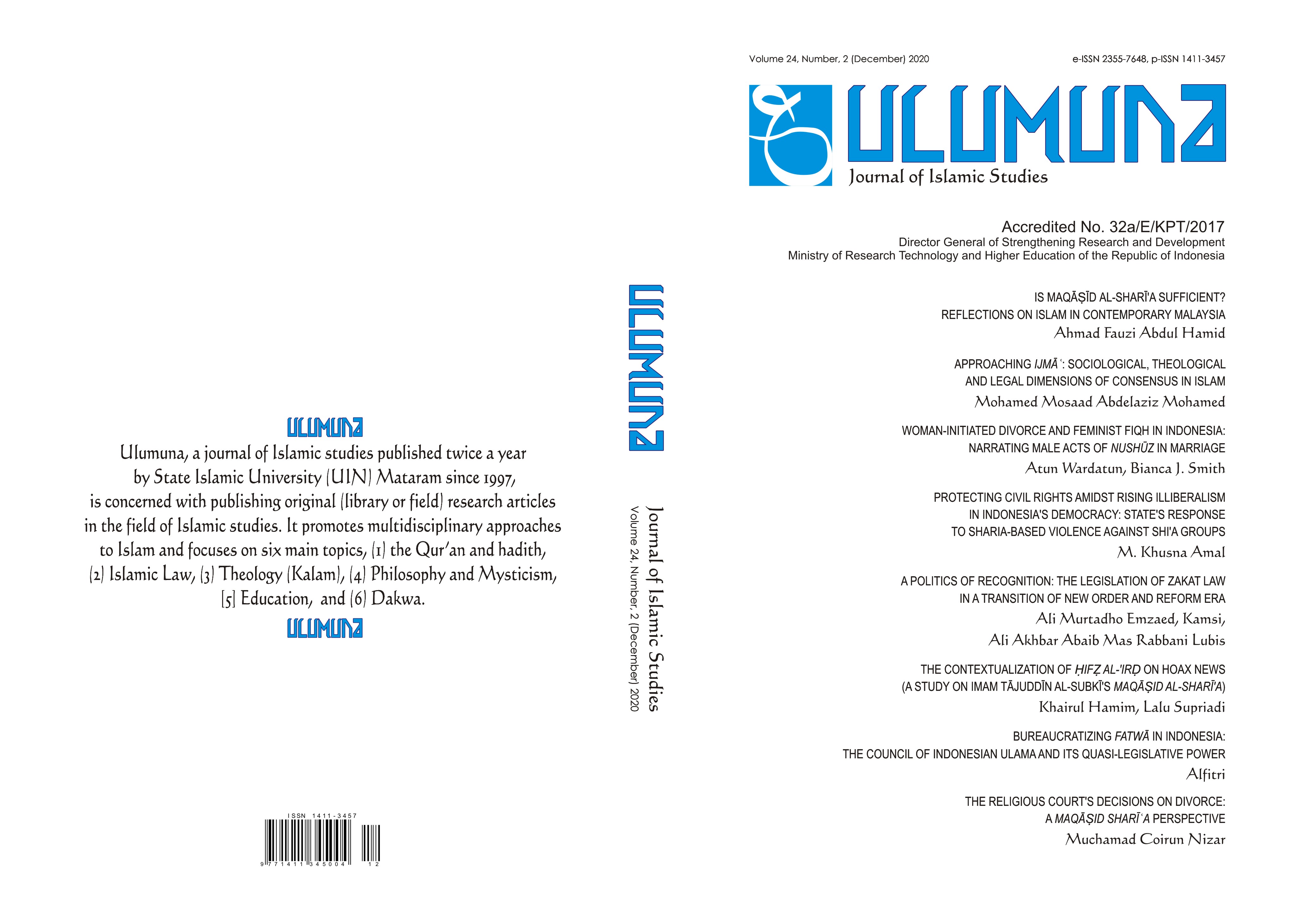
Woman-Initiated Divorce and Feminist Fiqh in Indonesia: Narrating Male Acts of Nushūz in Marriage
Abstract
This article examines the issue of woman-initiated divorce (cerai gugat) for the controversial reason in Indonesian Islam known as nushūz suami or a husband’s disobedience in marriage. In contrast to the Indonesian Compilation of Islamic Law which applies nushūz (disobedience) to wives only, our arguments draw on feminist jurisprudence (fiqh) to show how nushūz also applies to husbands who do not fulfill marital obligations. A husband’s nushūz is overlooked by classical scholars and Indonesian Islamic Law alike, yet when understood in a Qur’anic feminist context, it gives a depth of understanding about women’s choice to divorce as part of a wider gender justice process and the ‘gendering’ of divorce. Based on women’s post-divorce narratives about nushūz, we propose a feminist fiqh understanding of gender equality situated in tawḥīd as a concept with the potential to form egalitarian-inspired persons (muslimah reformis) and ‘essential’ and ‘true’ justice (keadilan hakiki), through reading religious texts and producing knowledge and policies that include women’s experiences and voices along with those of men’s (mubādalah).
Downloads
References
Andaryuni, Lilik. “Pemahaman Gender dan Tingginya Angka Cerai Gugat di Pengadilan Agama Samarinda.” FENOMENA 9, no. 2 (December 1, 2017): 155–174.
Anggoro, Taufan. “The Methodology of Contemporary Gender Interpretation: A Study of Qirā’ah Mubādalah.” Sawwa: Jurnal Studi Gender 15, no. 1 (April 21, 2020): 53–74.
Arifin, Johar, and Ahmad Mas’ari. “Tingginya Angka Cerai Gugat di Pengadilan Agama Pekanbaru dan Relevansinya dengan Konsep Kesetaraan Gender.” Marwah: Jurnal Perempuan, Agama dan Jender 16, no. 2 (December 30, 2017): 141–155.
Auda, Jasser. Maqasid Asy-Syari‘ah as Philosophy of Islamic Law: A System Approach. London & Washington: The Institute of Islamic Thought, 2008.
Barlas, Asma. Believing Women in Islam: Unreading Patriarchal Interpretations of the Qur’an. Austin: University of Texas Press, 2002.
Bowen, John R. Islam, Law, Equality In Indonesia: An Anthropology of Public Reasoning. Cambridge: Cambridge University Press, 2003.
Direktorat Jenderal Badan Peradilan Agama. “Data Perkara Peradilan Agama Tingkat Pertama.” Accessed December 1, 2020. https://badilag.mahkamahagung.go.id/perkara-diterima-dan-diputus-pada-tingkat-pertama/data-perkara/perkara-diterima-dan-diputus-pada-tingkat-pertama.
Erman. “Nusyûz Isteri dan Suami dalam al-Qurần (Sebuah Pendekatan Tematis).” Marwah: Jurnal Perempuan, Agama dan Jender 9, no. 1 (June 2, 2010): 1–14.
Faizah, Nur. “Nusyuz: Antara Kekerasan Fisik dan Seksual.” Al-Ahwal: Jurnal Hukum Keluarga Islam 6, no. 2 (May 20, 2016): 113–128.
Geertz, Hildred. The Javanese Family: A Study of Kinship and Socialization. New York: The Free Press of Glence, Inc, 1961.
Hamka. Tafsir al Azhar. Juz 5. Jakarta: Pustaka Panjimas, 1983.
Harwati, Tuti, Atun Wardatun, and Nunung Susfita. Fiqh an Nisa. Jakarta: Kencana, 2019.
Ḥawwā, Sa’īd. Al-Asās fī al-Tafsīr. Juz 2. Cairo: Dār al-Salām, 1989.
Kodir, Faqihuddin Abdul. Qirā’ah Mubādalah: Tafsir Progresif untuk Keadilan Gender dalam Islam. Yogyakarta: IRCiSoD, 2019.
Lev, Daniel S. Islamic Courts in Indonesia: A Study in the Political Bases of Legal Institutions. Berkeley: University of California Press, 1972.
Maimun, Mohammad Toha, and Misbahul Arifin Rais. “Fenomena Tingginya Angka Cerai Gugat dan Faktor Penyebabnya: Analisis Reflektif atas Kasus-kasus Perceraian di Madura.” Islamuna: Jurnal Studi Islam 5, no. 2 (2018): 157–167.
Mir-Hosseini, Ziba. Muslim Family Laws: Dismantling Discriminatory Frameworks from Within. Webinar on Global Conference on Muslim Family Law Reform, 2020. Accessed November 24, 2020. https://web.facebook.com/musawahmovement/videos/380268553231551/.
Mulia, Musdah. Ensiklopedia Muslima Reformis: Pokok-pokok Pemikiran untuk Reinterpretasi dan Aksi. Jakarta: Dian Rakyat, 2019.
Musarrofa, Ita. “Respons Muslimah Hizbuttahrir Indonesia (MHTI) terhadap Rancangan dan Undang-Undang Terkait Perempuan dan Keluarga.” Al-Qalam 21, no. 1 (January 9, 2016): 153–168.
Musawwar. “Problem Nusyuz dan Solusinya menurut Al Qur’an (Sebuah Tafsir Nir Kekerasan dalam Keluarga).” Qawwam: Journal for Gender Mainstreaming 1, no. 1 (2006): 5–28.
Nakamura, Hisako. Conditional Divorce in Indonesia. Cambridge: Islamic Legal Studies Program Harvard law School, 2006.
Nasir, Mohamad Abdun. “Islamic Law and Paradox of Domination and Resistance: Women’s Judicial Divorce in Lombok, Indonesia.” Asian Journal of Social Science 44, no. 1–2 (January 1, 2016): 78–103.
Nasution, Khoiruddin. “Women’s Rights In The Islamic Family Law Of Indonesia.” Jurnal Hukum IUS QUIA IUSTUM 12, no. 28 (2005): 147–159.
Nurhasanah, and Rozalinda. “Persepsi Perempuan Terhadap Perceraian: Studi Analisis Terhadap Meningkatnya Angka Gugatan Cerai Di Pengadilan Agama Padang.” Kafa`ah: Journal of Gender Studies 4, no. 2 (July 12, 2014): 181–201.
Nurlaelawati, Euis. “Muslim Women in Indonesian Religious Courts: Reform, Strategies, and Pronouncement of Divorce.” Islamic Law and Society 20, no. 3 (January 1, 2013): 242–271.
Nurmila, Nina. “Social and Religious Constructions of Motherhood in Indonesia: Negotiating Expectations of Childbearing, Family Size and Governmental Policies.” In Muslim Mothering: Global Histories, Theories and Practices, edited by M. Aziza Pappano and Dana M. Olwan. Bradford: Demeter Press, 2016.
O’Shaughnessy, K. Gender, State and Social Power in Contemporary Indonesia: Divorce and Marriage Law. London and New York: Routledge, 2009.
Pappano, M. Aziza, and Dana M. Olwan. “Muslim Mothering: Between Sacred Texts and Contemporary Practices.” In Muslim Mothering: Global Histories, Theories and Practices, edited by M. Aziza Pappano and Dana M. Olwan. Bradford: Demeter Press, 2016.
Rafi’ah, Nur. Nalar Kritis Muslimah: Refleksi atas Keperempuanan, Kemanusiaan, dan Keislaman. Bandung: Afkarunia, 2020.
Rais, Isnawati. “Tingginya Angka Cerai Gugat (Khulu’) di Indonesia: Analisis Kritis terhadap Penyebab dan Alternatif Solusi Mengatasinya.” AL-’ADALAH 12, no. 1 (2014): 191–204.
Risa, Yulia. “Tinjauan Yuridis Faktor Penyebab Cerai Gugat Di Pengadilan Agama Kelas II Kota Solok Tahun 2017.” Lex Librum : Jurnal Ilmu Hukum 4, no. 2 (2018): 701–713.
Robinson, K. M. “Gender Orders in the Indonesian Archipelago.” Kultur: The Indonesian Journal for Muslim Cultures 2, no. 2 (2002): 1–20.
Rofiq, Ahmad. Hukum Islam di Indonesia. Jakarta: Raja Grafindo Persada, 2003.
Rokhmad, Abu, and Sulistiyono Susilo. “Conceptualizing Authority of The Legalization of Indonesian Women’s Rights in Islamic Family Law.” JOURNAL OF INDONESIAN ISLAM 11, no. 2 (December 5, 2017): 489–508.
Saadah, Mazroatus. “Perempuan dan Perceraian: Kajian tentang Cerai Gugat di Pengadilan Agama Bekasi.” Al-Ahwal: Jurnal Hukum Keluarga Islam 11, no. 2 (December 11, 2018): 116–132.
Sābiq, Sayyid. Fiqh al-Sunnah. Juz 2. Beirut: Dār al-Fikr, 1983.
Saraswati, Rika. “Justice and the Identities of Women: The Case of Indonesian Women Victims of Domestic Violence Who Have Access to Family Court.” In Forum on Public Policy: A Journal of the Oxford Round Table, 1–21. Faculty of Law, Humanities and the Arts - Papers (Archive), 2013. https://ro.uow.edu.au/lhapapers/743.
Shahrur, Muhammad. Al-Kitāb wa al-Qur’ān: Qirā’ah Mu’āshirah. Cairo: Sina Publisher, 1992.
Siregar, Ully. “Apakah Independensi Perempuan Berkolerasi Dengan Perceraian?” Deutsche Welle. Last modified August 24, 2019. Accessed October 1, 2020. https://www.dw.com/id/apakah-independensi-perempuan-berkolerasi-dengan-perceraian/a-49616886.
Smith, Bianca J. “Sexual Desire, Piety, and Law in a Javanese Pesantren: Interpreting Varieties of Secret Divorce and Polygamy.” Anthropological Forum 24, no. 3 (July 3, 2014): 227–244.
Sofiani, Triana. “Pergeseran Pola Relasi Gender dan Eskalasi Cerai Gugat dalam Keluarga Perempuan Pekerja Migran.” JURNAL PENELITIAN 6, no. 2 (May 21, 2013): 1–14.
Ulfah, Isnatin. “Menggugat Perkawinan: transformasi kesadaran gender Perempuan dan Implikasinya Terhadap Tingginya Gugat Cerai di Ponorogo.” Kodifikasia: Jurnal Penelitian Islam 5, no. 1 (December 1, 2010): 1–22.
———. “Menolak Kesetaraan: Counter-Discourse Dan Motif Politik Di Balik Gagasan Anti Feminisme MHTI.” Musãwa Jurnal Studi Gender dan Islam 11, no. 1 (January 29, 2012): 85–114.
Wadud, Amina. Qur’an and Woman: Rereading the Sacred Text from a Woman’s Perspective. Oxford: Oxford University Press, 1999.
Wardatun, Atun. Negosiasi Ruang: Kritik feminis Liberal Terhadap Persoalan Kontekstual KHI. Mataram: Pusat Studi Wanita IAIN Mataram, 2007.
Wolf, Diana L. Factory Daughters: Gender, Household Dynamics and Rural Industrialization in Java. California: Berkeley University Press, 1992.
Copyright (c) 2020 Ulumuna

This work is licensed under a Creative Commons Attribution-ShareAlike 4.0 International License.

